

 Vehicle-mounted solutions

 Home
Home
"Thermal management engineer" for 3D printer
 Feng Zhi Yuan
 Jul 27,2026

In the field of Fused Deposition Modeling (FDM) 3D printing, there is a core component that is often underestimated by most users - the cooling fan. As an engineer who has long been involved with print quality, I can tell you categorically: over 60% of 3D printer malfunctions are directly related to inadequate thermal management. And the cooling fan is the executive core of this thermal management system.
Thermal management: the watershed from "being able to print" to "printing well"
When a 3D printer is operating, the nozzle temperature typically exceeds 180℃, the hotbed is maintained at 50℃–100℃, and the internal environment temperature of the chamber is generally between 60℃–90℃. Under such a harsh thermal environment, the cooling fan undertakes three distinct engineering tasks:
Heat dissipation at the hot end - preventing "thermal creep". Heat conducts upward from the heating block to the throat, causing the filament to soften or even carbonize before entering the nozzle, which is the most common cause of nozzle blockage. The core indicator of the fan at the hot end is wind pressure, which is recommended to be ≥2mmH₂O. The airflow must be precisely directed towards the heat sink, rather than "blowing in a wide range".
Model cooling determines the precision of the final shape. The molten filament freshly extruded from the nozzle must solidify and take shape within a very short period of time; otherwise, overhanging structures will sag, bridges will collapse, and layers will fail to adhere securely to each other. The goal of a model fan is to achieve a balance between directional air volume and air pressure. Centrifugal turbo fans, with their high air pressure and concentrated airflow, are the preferred solution for this scenario.
Chassis ambient temperature control - ensures system stability. Prolonged heat accumulation in electronic components such as motherboards and motor drivers can lead to performance degradation or even burnout. The chassis fan is responsible for establishing internal air circulation and maintaining a balanced thermal environment.
From "just enough" to "easy to use"
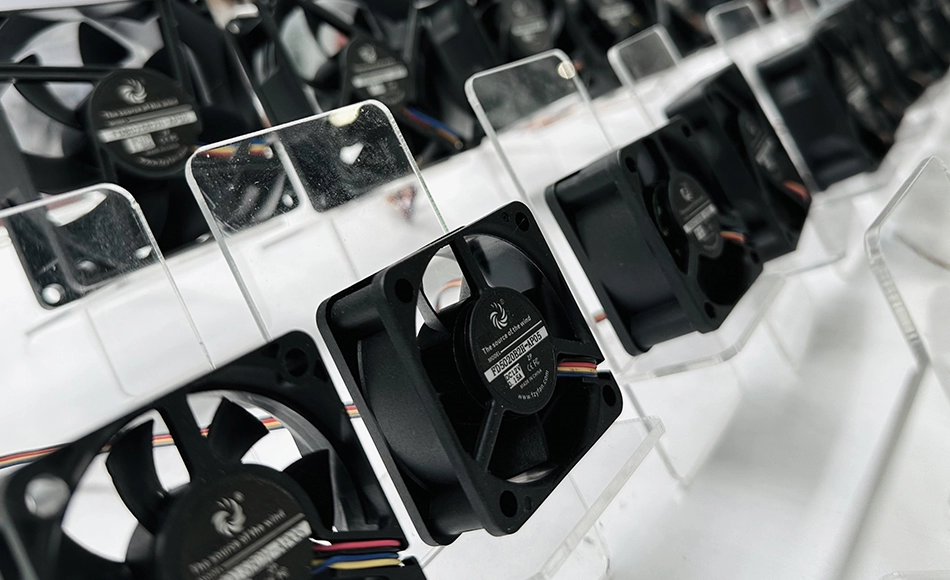
Many entry-level printers' original fans only manage to "spin," with crude air duct design, bearings that cannot withstand high temperatures, and no speed adjustment support. Actual measurements show that upgrading the original 3010 fan to a 4010 turbo fan can increase air volume by three times while reducing noise. Coupled with an optimized air shroud design that precisely directs airflow to the heat sink rather than the heating block, the temperature at the hot end can be further optimized.
The cooling fan is not an accessory that merely adds to the beauty of the design, but a core engineering component that determines the success rate of printing and the quality of the finished product. Choosing and using the right fan can truly unleash the performance of your 3D printer.
 The "core values" of a cooling fan: safety, longevity, peace of mind, and cost-effectiveness